

I spend a lot of evenings driving through St. Louis neighborhoods. Some nights I am completing a post-installation inspection and making final adjustments. Other times I am simply noticing what works and what does not on the homes around me.
Landscape lighting is subjective. Like any art form, it should reflect the homeowner’s style and the way they use their property. Still, certain mistakes consistently make an outdoor lighting system look less polished, less comfortable, and sometimes less safe.
Here are five of the biggest ones I notice.
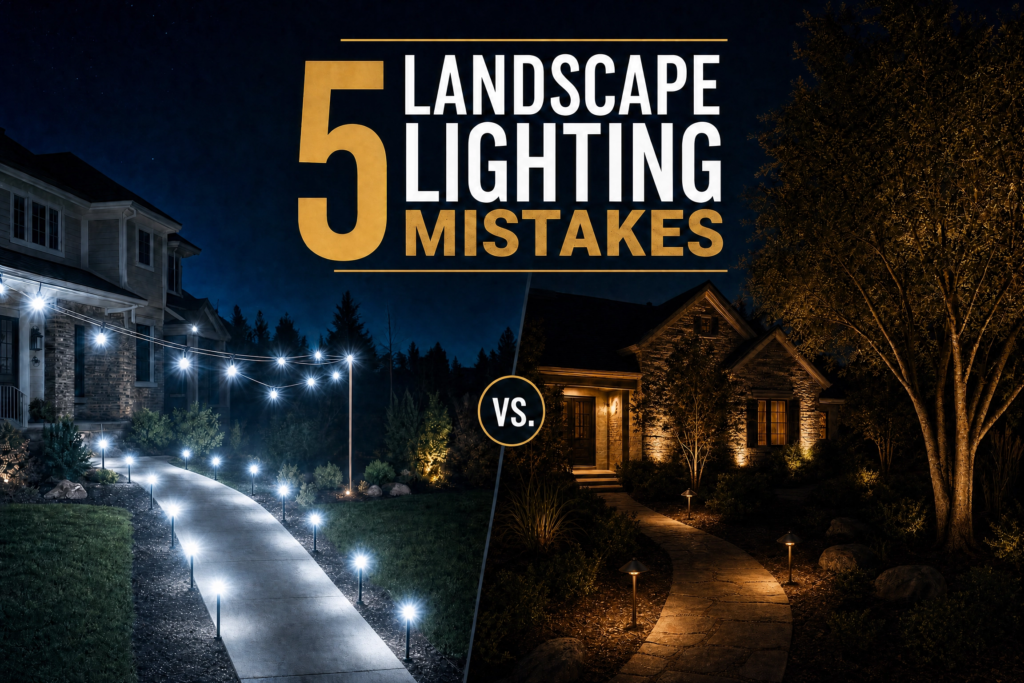
1. Path Lights That Look Like an Airport Runway
Path lighting has a legitimate purpose. It can improve visibility, make a walkway safer, and create a warm, welcoming approach to a home. The mistake is installing too many fixtures in perfectly repetitive rows.
When path lights are packed closely together on both sides of a walkway, the result can resemble an airport landing strip. It also puts too much attention on the fixtures themselves instead of the landscape they’re meant to highlight.
I prefer thoughtful spacing with intentional gaps. Each fixture should illuminate something worthwhile: a turn in the walkway, an elevation change, a planting area, or a section where added visibility genuinely helps.
Path lights are also top-heavy, so poorly installed fixtures tend to lean over time and become an eyesore.
2. Choosing the Wrong Color, Brightness, or Beam Spread
Many homeowners still associate LED lighting with harsh blue or bright white light. It does not have to look that way. For most traditional residential designs, I prefer a warm white color temperature around 2700 Kelvin.
Brightness matters just as much. My goal is never to make a client’s home the brightest house on the block. I want it to look subtle, consistent, and elegant.
Beam spread needs to match the feature, too. A narrow optic may be ideal for a tall column or tree, while a wider beam may be better suited for a broad wall or planting area.
Good landscape lighting design comes down to getting all of these details right together: color temperature, lumen output, fixture placement, and optic, chosen individually for every application. It’s a big part of why we walk every client through our design process before a single fixture goes in the ground.
3. Ignoring the Homeowner’s Most Important Views
A lighting system should be designed from the places where it will actually be experienced.
On the front of a home, that may be the view from the street or driveway. In the backyard, it may be the view from the patio, but it could just as easily be what the homeowner sees through the kitchen or living room windows during winter.
I often ask clients what they want to see when they look outside. It might be a mature tree, a sculpture, a water feature, a stone wall, or an interesting architectural detail.
A professional design considers these vantage points and creates focal points the homeowner can enjoy throughout the year, not just on the rare evening they walk the yard.
4. Treating Lighting Like a Side Service
Electricians, landscapers, and irrigation contractors all provide valuable services. I know because I started as a landscaper who also installed lighting. At the time, I was trying to offer dozens of different services.
Today, lighting is all we do.
There is a real difference between someone who can connect a fixture and someone who understands how to create depth, contrast, balance, and visual comfort.
Every light should have a reason for being there. Otherwise, the project becomes a collection of fixtures instead of a complete nighttime experience.
A specialist also thinks about glare, light spilling into windows, uncomfortable illumination across walking areas, daytime appearance, serviceability, and how the system will mature as the landscape grows.
5. Sagging Bistro Lights and Harsh Floodlights
Professionally installed bistro lighting should look clean during both the day and night. Loose strands, burned-out bulbs, rusty hardware, and excessive sag immediately make a space feel unfinished.
We support our outdoor string lighting with stainless steel cable and hardware. That keeps each run taut, reduces stress on the electrical cord, and prevents the installation from becoming a rusty daytime eyesore.
Hanging the lights by their electrical wire alone can also damage the internal copper or protective coating over time.
Harsh floodlighting creates a different problem. A giant floodlight may provide functional illumination, but it should not wash an entire property from dusk until dawn.
Soffit lights can be especially problematic when they create bright streaks down a façade, shine into windows, or expose the light source directly to someone standing below.
Better Lighting Starts With Intention
The common thread behind all five mistakes is a lack of intention.
Great outdoor lighting is not about installing the maximum number of fixtures. It is about deciding what deserves attention, controlling where the light goes, and creating a result that feels natural.
If your current system includes leaning path lights, harsh glare, sagging bistro strands, or fixtures that seem to serve no purpose, we would be happy to help.
Landscape Lighting Guys offers free consultations throughout the St. Louis area, and we would love the opportunity to create a professional design that helps you enjoy your property in an entirely new way after dark.